5 Augmented Reality Services for Digital Transformation in 2026
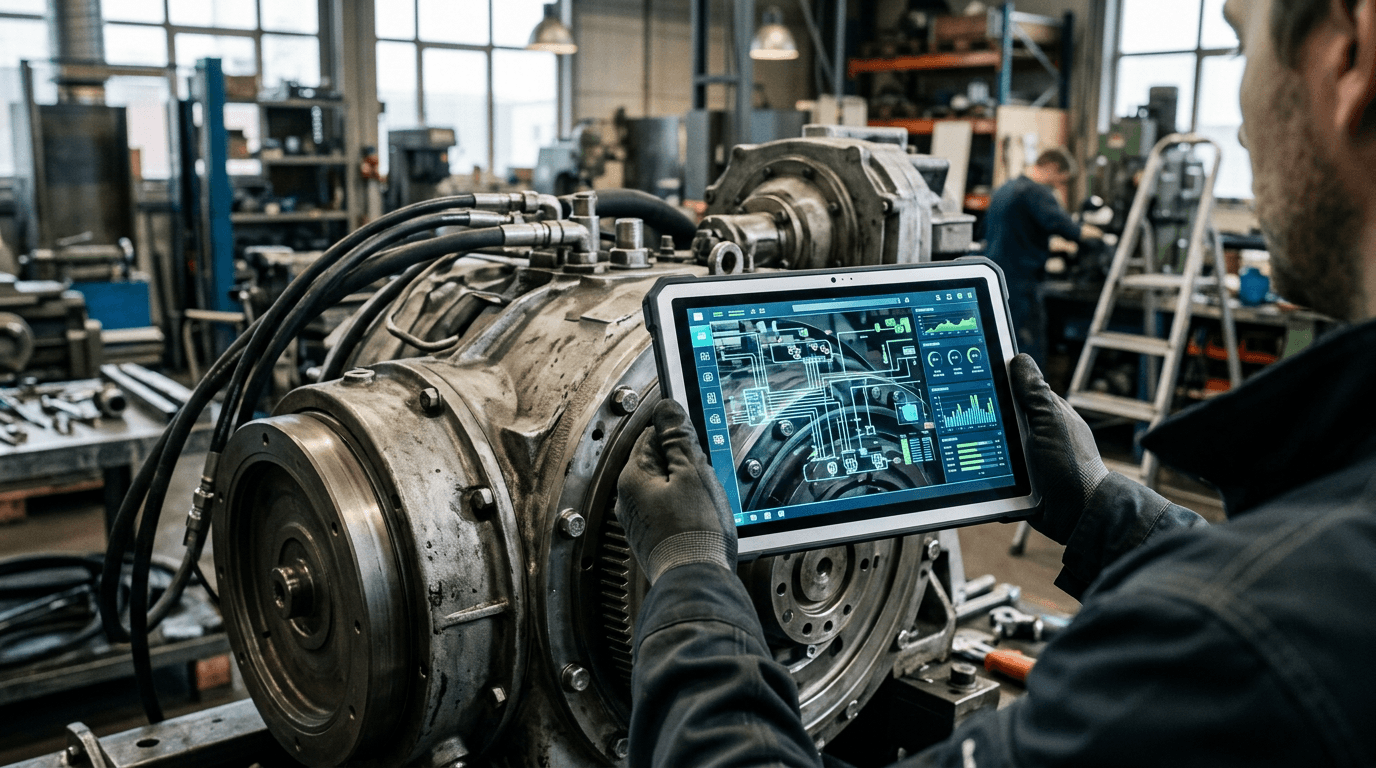
A maintenance technician stands on a loud factory floor, holding a tablet up to a faulted drive unit. Instead of flipping through a 400-page diagnostic PDF, they see real-time torque limits superimposed directly over the physical casing. That is what industrial augmented reality services look like in practice: not a floating, disconnected metaverse, but an immediate data overlay that cuts diagnostic time from hours to seconds. The technology works by anchoring live telemetry to physical coordinates, but the complexity lies entirely in the backend architecture required to stream that data securely.
Quick Summary
Implementing immersive digital architecture requires mapping spatial logic onto your existing business infrastructure. It moves telemetry, schematics, and marketing assets out of flat dashboards and anchors them to physical objects in real time.
- Enterprise rollouts depend heavily on continuous backend integration to maintain connections with legacy ERP systems.
- Industrial implementations focus on constructing secure digital twins and establishing direct programmable logic controller (PLC) supervision.
- Marketing applications prioritize low-latency delivery over global content delivery networks to reach everyday mobile devices.
Table of Contents
- What Dictates Your Immersive Architecture
- 1. Reply S.p.A.
- 2. Engineering Ingegneria Informatica S.p.A.
- 3. Immensive
- 4. Two Reality
- 5. FM Automazione S.r.l.
- Where These Architectures Actually Belong
- Recommended Reads
What Dictates Your Immersive Architecture
Before comparing vendors, you must define the primary function of the spatial data you intend to project. The backend requirements for an industrial safety overlay share almost nothing with the requirements for a consumer marketing campaign. We evaluate these options through the lens of Primary Application Focus, categorizing solutions into three distinct environments:

Enterprise IT & Platform Integration
This category connects spatial computing to heavy backend application services. It is designed for massive, multi-national rollouts where the headset must authenticate against active corporate directories and pull live inventory or performance metrics from a global database.
Industrial Digital Twins & Control
Built strictly for the factory floor, this category wires the visual interface directly into SCADA systems, PLCs, and machinery supervision networks. It prioritizes low-latency, localized data over global accessibility.
Immersive Marketing & Training
Optimized for consumer delivery, this category relies on lightweight mobile formats and fast CDNs. It focuses on rendering visual narratives for mass-market hardware rather than connecting to secure industrial databases. Integrating these platforms securely still requires robust data protocols, similar to those outlined in standard privacy policies for tech platforms.
| Product | Primary Application Focus | Features | Pros | Cons | Target Audience |
|---|---|---|---|---|---|
| Reply S.p.A. | Enterprise IT & Platform Integration | Custom platforms, IoT integration, persistent overlays | Connects to legacy ERPs, Global scale, Proprietary platforms | Heavy architecture, Slow deployment, High IT overhead | Multinational corporations |
| Engineering Ingegneria Informatica S.p.A. | Enterprise IT & Platform Integration | Smart Operator app, EngGPT 2 private AI model | Secure local AI, Hazardous environment focus, Governed data | Duplicates AI models, Complex setup, IT friction | Heavy industry & utilities |
| Immensive | Immersive Marketing & Training | Matterport 360, Unreal Engine training, Mobile-first | Bypasses expensive headsets, Frictionless access, High-level training | Low polygon count, Lacks industrial CAD, Mobile constraints | Marketing & education teams |
| Two Reality | Immersive Marketing & Training | Real-time 360 video, RTMP/HLS/DASH CDNs, Step-by-step AR | Global streaming reach, Live event capability, Mobile overlays | Requires constant internet, No SCADA links, Buffering risks | Event marketers & brands |
| FM Automazione S.r.l. | Industrial Digital Twins & Control | PLC/HMI/SCADA logic, Native facility control, Real-time twins | Zero-latency local data, Deep machinery links, Direct control | Rigid visual design, Over-engineered for retail, Not for app stores | Facility engineers & industrial IT |
1. Reply S.p.A.
Integrating spatial computing across a global workforce often breaks at the data layer, where legacy application management services fail to parse 3D coordinates. Reply S.p.A. handles that precise translation for large organizations from its headquarters in Turin, Italy. Operating firmly in Enterprise IT & Platform Integration, this architecture should never be compared against lightweight, standalone mobile apps.
The firm builds its architecture on a wide roster of proprietary application platforms, including Axulus, Brick Reply, LEA Reply, Discovery Reply, Pulse, TamTamy Reply, Sonar, and China Beats. Instead of deploying isolated visual tools that sit disconnected from core systems, they structure spatial data as integrated application services. Their systems pull real-time operational data - such as inventory metrics or machinery health - and push it into customized immersive experiences combining AR, VR, and interactive environments. Founded in 1996 by a group of IT managers led by Mario Rizzante, the company focuses on heavy backend integration. The mechanism relies on establishing a persistent data pipeline where changes in the physical supply chain instantly update the virtual overlay, requiring continuous, secure synchronization between the immersive hardware and the central corporate database.
Enterprise breadth demands extensive integration timelines
The sheer number of proprietary platforms required to make this architecture function means the deployment carries substantial architectural overhead. Teams looking for a quick visualization asset will find themselves navigating complex architecture reviews, security clearances, and integration protocols designed for massive, multinational rollouts. What would make me hesitate is the intensive training required for internal IT teams to maintain so many distinct proprietary systems once the initial deployment finishes. This structural weight makes the system entirely unsuitable for short-term campaigns or localized training programs that lack dedicated engineering support.
Organizations should authorize this framework when their spatial computing initiative must tie directly into global ERP instances and existing IoT management backbones.
Pros
- Pulls live telemetry from existing corporate databases
- Supports multi-national scale and complex user authentication
- Combines AR, VR, and interactive digital environments
Cons
- Architectural overhead severely delays initial deployment
- Requires managing a multitude of distinct proprietary platforms
- Mandates heavy internal IT training to maintain the pipeline
2. Engineering Ingegneria Informatica S.p.A.
According to its corporate profile, Engineering Ingegneria Informatica S.p.A. employs approximately 14,000 workers across Europe, South America, and the United States. This Rome-headquartered digital transformation provider targets heavy industry and utility networks where workers need hands-free visual guidance in hazardous physical environments. Positioned within Enterprise IT & Platform Integration, this framework should not be evaluated against consumer-facing event marketing tools.
The core of their augmented reality deployment relies on the Smart Operator application, a system that overlays visual guidance directly onto complex industrial operations. To manage the underlying data architecture and prevent sensitive schematics from leaking into public networks, they deploy EngGPT 2. This Italian private Generative AI foundation model anchors the secure and governable digital architectures behind the headsets. When a worker requests a maintenance procedure, the application queries the private model, which retrieves and formats the appropriate localized schematics without ever routing the prompt through a public cloud API. This localized processing ensures that all visual overlays comply with strict corporate governance while still providing responsive, context-aware guidance to the technician standing on the floor.
Proprietary foundation models isolate the data pipeline
EngGPT 2 is a custom, regionally developed AI model. Relying on it introduces a localized dependency. This complicates global IT standardization. Organizations that already standardized their internal knowledge bases on major global language models face a severe duplication of effort. They must map their services engineering processes to a secondary proprietary model. I would hold off on this vendor if your corporate IT strategy explicitly mandates a single, centralized AI vendor for all natural language and visual queries.
Deploy this enterprise solution when your industrial workforce requires secure, AI-governed visual instructions that strictly forbid data transmission to public cloud infrastructures.
Pros
- Smart Operator app leaves workers completely hands-free
- Private foundation model keeps schematics off public clouds
- Designed specifically for hazardous industrial environments
Cons
- Forces integration with a regional, proprietary AI model
- Duplicates effort for teams already using global language models
- Standardizing the secondary model creates internal IT friction
3. Immensive
The most common mistake teams make when commissioning spatial computing is building a heavy, hardware-dependent application for an audience that only owns standard smartphones. Immensive, founded in Aversa, Italy in 2016, bypasses expensive headset requirements by optimizing their spatial output for everyday mobile screens. Operating within Immersive Marketing & Training, this mobile-first approach should not be compared against heavy industrial CAD simulation engines.
The custom software development studio utilizes Matterport technology to design and publish immersive 360-degree virtual tours. Instead of rendering heavy localized physics engines that drain mobile batteries, they stitch spatial data into a lightweight, web-accessible format viewable on standard mobile devices. For projects requiring deeper structural work, they pivot to comprehensive 3D environments. The studio runs high-level Unreal Engine training courses - including a 16-hour 3D Studio Max Modeling course requiring 4 hours per week of attendance - to build internal capabilities for complex rendering. This dual technical approach allows them to develop immersive VR storytelling solutions engineered to replace traditional narratives in sectors like marketing and education. The underlying mechanism focuses on compressing high-fidelity spatial data so it streams seamlessly without requiring the end-user to install dedicated viewing software.
Practical rule: Never buy a consumer-facing immersive solution based on its peak rendering quality in the studio; evaluate its polygon count against the average mobile bandwidth of your target demographic.
Mobile distribution caps the visual fidelity
Delivering 360-degree content natively to mobile browsers severely restricts the final asset's polygon count, rendering speed, and interactive depth. Complex, multi-layered industrial simulations cannot run through a lightweight Matterport web viewer. Engineering teams must look elsewhere. They cannot manipulate live 3D models of active machinery. If the user cannot rotate and dissect a high-resolution component in real time without crashing the browser, the application fails as a serious diagnostic tool.
Select this custom studio when the project demands mass-market consumer education and frictionless mobile access over high-fidelity physical simulations.
Pros
- Bypasses the need for expensive dedicated VR headsets
- Leverages Matterport technology for rapid 360-degree tours
- Offers deep 3D Studio Max training for internal capability building
Cons
- Browser delivery severely restricts rendering polygon counts
- Lacks the depth necessary for live industrial CAD manipulation
- Interactive elements remain limited by mobile hardware constraints
4. Two Reality
When a brand's traditional digital channels stop converting, the sudden drop in engagement often triggers a search for experiential, high-bandwidth alternatives. Established in 2010, Two Reality operates as a specialized production company developing immersive virtual and augmented reality experiences designed to boost audience visits and revenue. Positioned within Immersive Marketing & Training, this event-driven architecture should not be compared against secure, offline industrial control networks.
The agency combines artificial intelligence with virtual reality to assemble customized brand environments that respond dynamically to user input. To guarantee these spatial experiences do not buffer during live marketing events, they utilize RTMP, HLS, and DASH protocols layered over a global CDN. This networking architecture supports real-time 360-degree video streaming directly to consumer devices regardless of physical location. Moving beyond purely promotional applications, they also develop step-by-step interactive augmented reality applications engineered to guide workers through machinery operation. The mechanism here relies on pushing interactive overlays to mobile viewports, using the smartphone's camera to anchor digital instructions to physical buttons and levers in real time, effectively turning the phone into a localized training manual.
Global streaming architecture lacks local network persistence
The underlying network architecture prioritizes live video transmission. It favors consumer-facing interactive layers over a public CDN. As a result, it lacks native integration with deep industrial control networks. Facilities attempting to wire these visual guides directly into live factory floor databases will find the software stack missing the necessary industrial connectivity protocols. I would hesitate to deploy this for mission-critical manufacturing. Any disruption in outbound internet connectivity will instantly sever the application's ability to pull real-time operational instructions.
Commit to this production agency when executing high-traffic brand activations that rely on streaming live 360-degree video across distributed global audiences.
Pros
- Utilizes RTMP, HLS, and DASH protocols for live 360-degree streaming
- AI integration ensures brand environments respond to user actions
- Replaces static manuals with step-by-step visual machinery guides
Cons
- Applications fail immediately if outbound internet connectivity drops
- Missing the legacy protocols required for deep SCADA integration
- Buffering remains a risk on congested event-floor cellular networks
5. FM Automazione S.r.l.
Unlike production agencies focused on brand storytelling and global CDNs, FM Automazione S.r.l. operates entirely on the active factory floor and deep inside the localized server room. Headquartered in Treviolo, Bergamo, this provider wires spatial computing directly into heavy industrial machinery and facility infrastructure. Operating strictly within Industrial Digital Twins & Control, this infrastructure should never be compared against web-based consumer storytelling applications.

Founded in 1991 to deliver custom PLC, HMI, SCADA, and DCS supervision software solutions, the company integrates augmented and virtual reality services to construct functional digital twins of physical hardware. Rather than relying on cloud databases, they build applications that speak native industrial protocols. This mechanism ensures that an AR headset displays exact, real-time telemetry pulled straight from the machine's localized controller. Their capability in managing heavy, integrated infrastructure is evidenced by their development of the centralized automated control system managing HVAC, lighting, and security for the AlbinoLeffe Stadium and Academy. By mapping the visual application directly to the supervision software, they eliminate the latency typically introduced when routing factory data through external sdm services.
Deep SCADA integration alienates commercial developers
The profound specialization in legacy supervision systems and industrial controllers makes this an exclusively industrial execution model. Retailers, educators, or marketing teams looking to build lightweight, consumer-facing mobile applications will find this engineering approach completely misaligned with user-friendly app store deployment conventions. Attempting to force a consumer application through a developer accustomed to rigid PLC logic will result in an over-engineered, visually austere product that frustrates everyday smartphone users.
Mandate this engineering partner when your digital twin must interface directly with live PLC data and facility-wide automated control systems.
Pros
- Wires immersive visual displays directly into native SCADA logic
- Pulls telemetry locally, bypassing the latency of cloud routing
- Proven capability in massive facility-wide supervision software
Cons
- Visual design prioritizes rigid telemetry over consumer aesthetics
- Development approach is entirely misaligned with commercial app stores
- Over-engineered for simple mobile visualization tasks
Where These Architectures Actually Belong
Evaluating these providers requires accepting that spatial computing is not a single industry, but rather a visualization layer applied to entirely different backend disciplines.
Organizations demanding Enterprise IT & Platform Integration must choose frameworks built to digest massive corporate databases. When spatial computing needs to read inventory levels across three continents or query an internal AI model without violating corporate governance, heavy platform architectures are the only viable path.
Facilities operating inside Industrial Digital Twins & Control have no use for global streaming protocols. When the objective is preventing a machine failure, the headset must read the localized PLC directly. Cloud latency is unacceptable on the factory floor, making direct supervision software integration mandatory.
Teams functioning in Immersive Marketing & Training face the exact opposite constraint. Their success depends on bypassing heavy headsets and bypassing localized firewalls entirely. If the objective is audience engagement or widespread consumer education, the architecture must leverage lightweight web viewers and robust CDNs to deliver the experience directly to the device the user already owns.