Comparing Business Process Reengineering and Automation Strategies
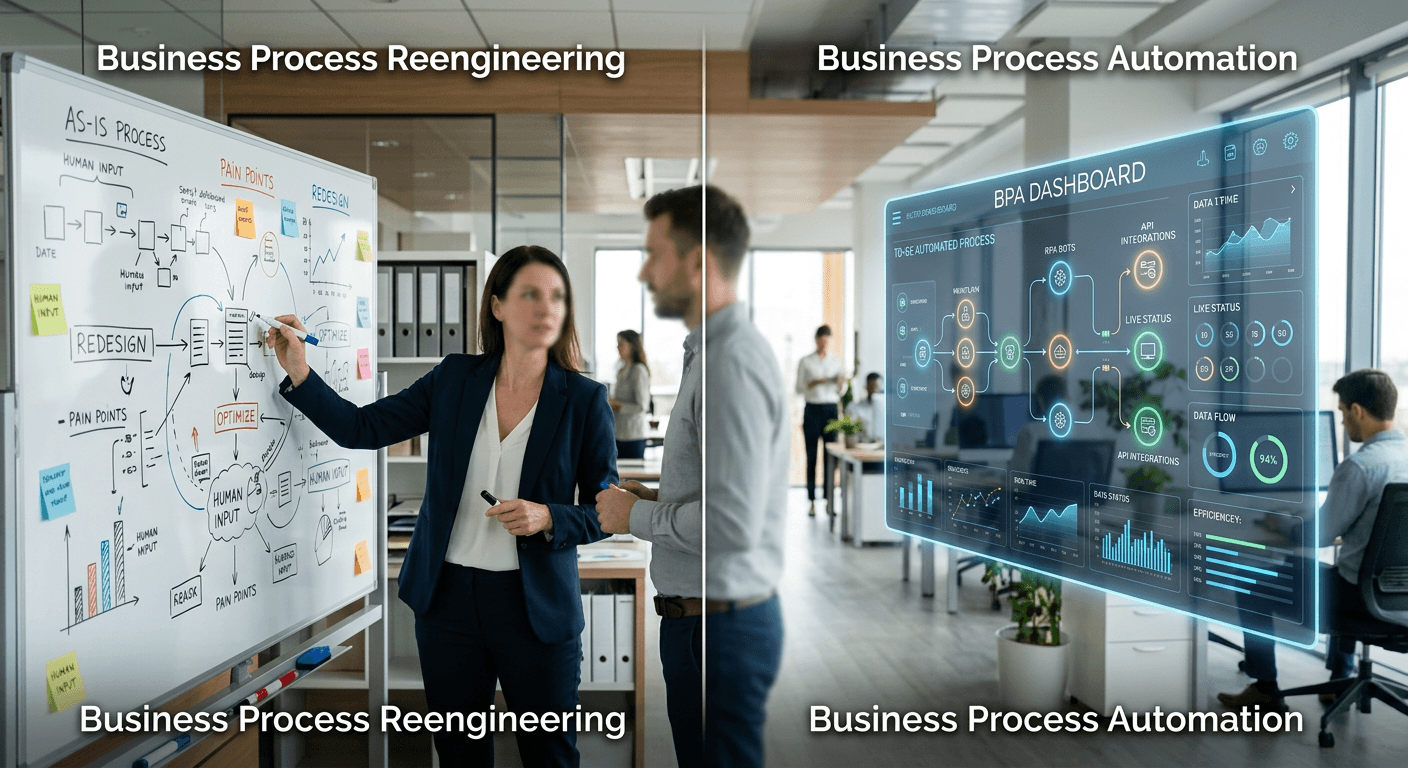
Optimizing organizational performance requires a precise understanding of the distinction between business processing reengineering and operational technology integration. While many leaders conflate the two, they serve fundamentally different roles in a robust business enterprise architecture, where one seeks to strip away legacy inefficiencies and the other strives to accelerate existing workflows through digital execution. Distinguishing these paths is essential for companies aiming to improve their market position without incurring unnecessary structural risk.
Quick Summary
Business process reengineering is the radical redesign of core workflows to achieve dramatic improvements in productivity and service, while business process automation utilizes software to execute repetitive tasks without manual intervention. Success depends on aligning these initiatives with long-term strategic goals and current organizational capabilities.
- Reengineering focuses on the "why" and "how" of a process, often leading to fundamental structural changes.
- Automation focuses on the "speed" and "consistency" of a task, typically by removing human touchpoints.
- Integration between both strategies ensures that only optimized, value-added processes are automated.
- Proper planning supports business continuity management by minimizing disruption during transition phases.
Table of Contents
- Quick Summary
- The Fundamentals of Business Processing Reengineering
- The Mechanics of Business Process Automation
- Strategic Alignment in Business Enterprise Architecture
- The Role of Business Process Modeling
- Mitigating Risks with Business Continuity Management
- Comparison of Core Methodologies
- Frequently Asked Questions
- Recommended Reads

The Fundamentals of Business Processing Reengineering
Business processing reengineering is not a mere incremental upgrade; it is a fundamental rethinking of how work is performed. When an organization finds itself hampered by legacy bottlenecks or siloed departments, reengineering serves as the catalyst for structural change. It requires mapping the entire workflow from start to finish and questioning the necessity of every step, handoff, and approval gate. If a task does not add direct value to the end customer, it is often eliminated or significantly consolidated during this phase.
Successful reengineering initiatives often move away from functional specialization toward process-based teams. By aligning workflows with the customer journey rather than the internal organization chart, firms can significantly reduce latency. Organizations often use the business process modeling approach to visualize these current-state workflows before stripping them down to their core components. This methodology demands executive sponsorship, as the shift often challenges established power dynamics and long-standing corporate cultures.
The Mechanics of Business Process Automation
Once a process is lean and optimized, business process automation becomes the primary engine for scale. Automation replaces human-led, repetitive, and rule-based tasks with digital logic. This is distinct from reengineering because it generally does not change the fundamental nature of the work; rather, it changes the medium of execution. By applying software to existing tasks, companies can drastically reduce error rates and free human capital for high-value strategic decision-making.
Technological deployment in this area typically follows a phased approach, starting with high-volume, low-complexity tasks. Modern automation tools can integrate across legacy software stacks, allowing for a seamless flow of data between disjointed systems. However, a major trap for many firms is "automating the mess." If a process is fundamentally flawed or inefficient, applying automation only accelerates the speed at which errors or bottlenecks occur. This is why practitioners often reference the terms of service associated with their digital platforms to ensure data integrity remains compliant during these transitions.
Strategic Alignment in Business Enterprise Architecture
Integrating both methodologies into a cohesive business enterprise architecture is critical for long-term survival. A mature architecture provides the blueprint for how these changes affect data flow, security, and infrastructure. Without a holistic view, reengineering and automation projects often result in "technical debt," where new systems fail to communicate with each other, leading to increased complexity rather than simplicity.
Architectural planning involves setting clear guidelines for technology selection, vendor management, and data governance. It serves as the bridge between high-level executive vision and the granular requirements of the IT department. Leaders should treat their architectural documentation as a living document, evolving alongside the business as new market demands arise or as the regulatory environment changes.
The Role of Business Process Modeling
Effective business process modeling is the diagnostic tool of the modern enterprise. It allows stakeholders to create a visual representation of the business logic, identifying overlaps and redundancies that would otherwise remain invisible in spreadsheets or prose documentation. Whether using BPMN (Business Process Model and Notation) or simpler flow-based diagrams, modeling serves as a common language between technical developers and non-technical business stakeholders.
Pro Tip: Always maintain a "Current State" and a "Future State" model. Comparing these two versions provides a clear roadmap for stakeholders and makes the ROI of reengineering or automation projects easier to justify to board-level leadership.
Furthermore, accurate modeling acts as a precursor to automation. You cannot automate what you have not yet defined. When a process is modeled with enough granularity, it becomes significantly easier to identify exactly which segments are ready for machine-led execution versus those that require human intuition and oversight.
Mitigating Risks with Business Continuity Management
Any significant change to core business processes introduces operational risk. Business continuity management is the essential safety net that prevents organizational disruption when reengineering projects or automated system migrations fail or underperform. This includes establishing rollback protocols, testing redundant systems, and ensuring that critical knowledge remains distributed even if specific automated workflows fail.
Effective continuity planning involves identifying "single points of failure" within the new process design. If a high-volume automated workflow goes offline, does the organization have a manual fallback procedure? The goal is to ensure that while processes may be redesigned for maximum efficiency, the organization remains resilient against both technical outages and human error. Always review your privacy policy and data recovery standards as part of this risk assessment.
Comparison of Core Methodologies
| Feature | Business Process Reengineering | Business Process Automation |
|---|---|---|
| Primary Goal | Radical improvement in efficiency | Increased speed and consistency |
| Scope | Structural and organizational | Task-based and technical |
| Complexity | High (involves cultural change) | Moderate (technical implementation) |
| Focus | Redesigning workflows from scratch | Enhancing existing workflows |
| Outcome | New process architecture | Digital execution of tasks |
Frequently Asked Questions
How do I know whether to choose reengineering or automation?
Start by analyzing the current process. If the process is inherently broken, bloated, or obsolete, it requires reengineering. If the process is sound but suffers from high manual overhead and latency, it is a candidate for automation.
Can both strategies be implemented simultaneously?
Yes, but they should be sequenced. Reengineer first to ensure the process is valid and necessary, then automate the refined steps to capture efficiency gains.
What is the biggest mistake organizations make during reengineering?
The most common failure is trying to automate a flawed process. This ignores the root cause of inefficiency and simply makes a bad process move faster, leading to higher error volumes.
How does business continuity management affect these strategies?
It ensures that the transition between current and future states does not result in total service loss. It provides the frameworks for testing and fallback, protecting the customer experience during structural changes.