How to Build a Scalable Building Management System in 2026
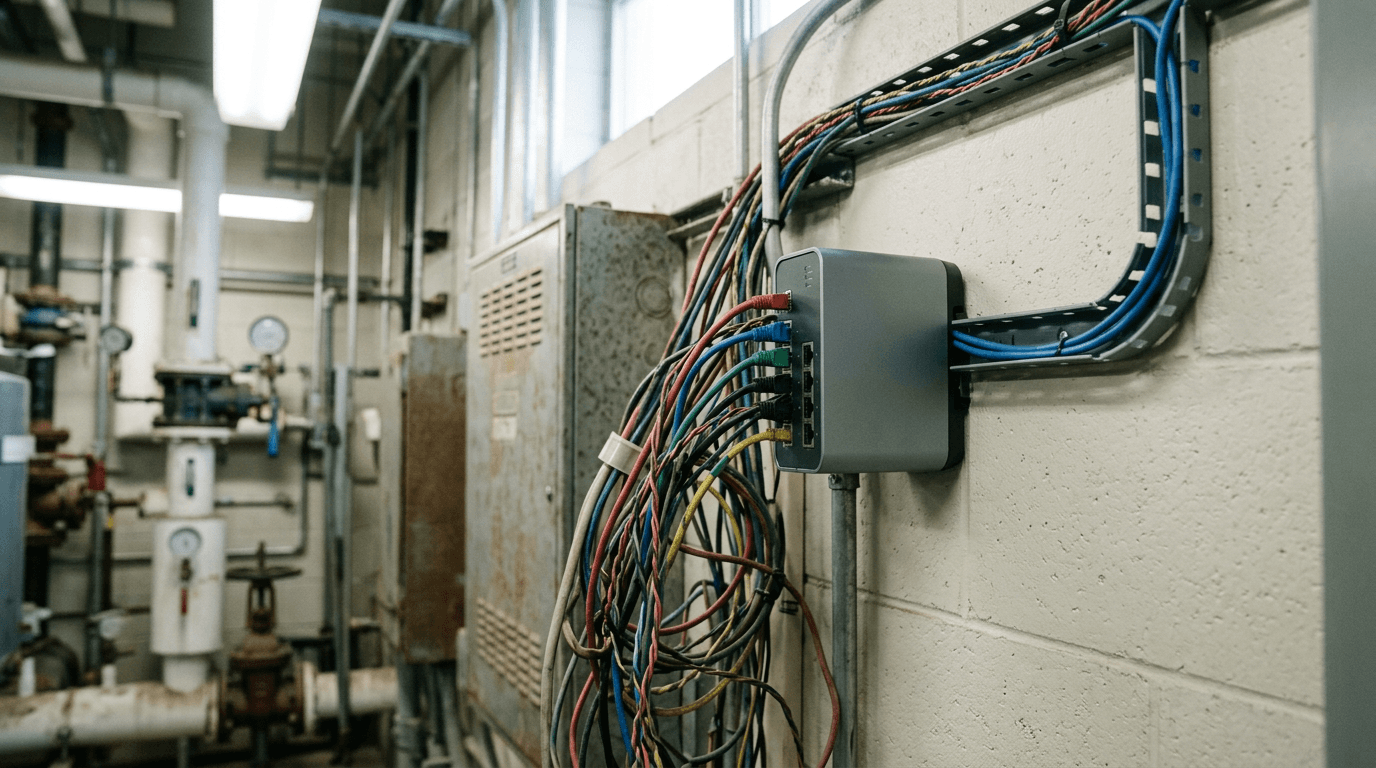
The fundamental mistake developers make when approaching smart facilities is treating a building like a giant web application. In software, a dropped packet means a stalled page load; in a facility, a dropped packet means an air handler drives a server room to 95 degrees, or an access control gate traps employees in a lobby. A modern building management system must reconcile the slow, deterministic world of industrial hardware with the high-speed, scalable demands of cloud architecture. It is not just about routing data to a dashboard; it is about establishing a fault-tolerant nervous system that handles physical consequences.
Quick Summary
A scalable building management system (BMS) is an integrated network of hardware controllers, edge processing units, and cloud analytics platforms designed to automate physical facility operations. This guide covers the exact architecture required to normalize disparate industrial protocols, secure the network perimeter, and execute low-latency commands without relying solely on cloud connectivity.
- Standardize on IP-based protocols at the controller level before data leaves the floor.
- Decouple data ingestion from control logic using edge gateways.
- Implement strict network segmentation between IT and operational technology (OT).
- Use standardized tagging models to normalize telemetry for cloud analytics.
Table of Contents
- 1. Map the Hardware Protocol Architecture
- 2. Design the Network Topologies for Services Engineering
- 3. Centralize the Data Ingestion and Normalization
- 4. Implement Edge Computing for Low-Latency Automation
- 5. Define Access Control and SDM Services Integration
- Common Pitfalls & Troubleshooting
- FAQ
- Recommended Reads
1. Map the Hardware Protocol Architecture
The foundation of any building management system is the physical hardware layer: chillers, air handling units, lighting relays, and variable frequency drives. These devices rarely speak modern web protocols. Instead, they rely on serial communication standards that have existed for decades, primarily BACnet MS/TP and Modbus RTU. The architectural challenge in building construction engineering is not replacing these reliable devices, but bridging their localized chatter into a unified, IP-routable format.

To do this, you must map every physical point in the facility to an IP gateway. The mechanics involve deploying field controllers that poll serial devices locally and expose that data over Ethernet using BACnet/IP or Modbus TCP. This step requires physical termination, baud rate matching, and precise network addressing. You cannot simply plug a serial adapter into a server and expect it to handle thousands of polling requests per second; the serial bus will saturate, causing massive latency and dropped commands.
Practical rule: Never place more than 30 serial devices on a single MS/TP network segment, regardless of the manufacturer's stated limit, to ensure polling cycles remain under two seconds.
The mistake people actually make here is daisy-chaining too many legacy devices onto a single trunk, thinking the gateway can buffer the traffic. What happens in reality is token-passing collisions on the serial line. When the cloud sends a command to open a damper, the gateway has to wait for the token to reach the specific device. If the bus is overloaded, the command times out before the damper ever receives it, leading operators to falsely believe the hardware is broken.
2. Design the Network Topologies for Services Engineering
Once your data is on an IP network, it must be transported securely. A smart building cannot share the same flat network as the corporate Wi-Fi or the guest internet. The network topology must physically and logically isolate operational technology (OT) from information technology (IT). Services engineering dictates that life-safety and critical infrastructure systems have dedicated switching, or at minimum, rigidly enforced VLANs with strict firewall rules blocking outbound internet access from the controllers.
The mechanics of this involve setting up a converged building network (CBN). Field controllers connect to edge switches, which trunk up to a core OT switch. The only device allowed to traverse the boundary between the OT network and the outside world is the edge gateway. Controllers should never be assigned public IP addresses, and they should never resolve DNS queries. They communicate strictly via hardcoded IP addresses to the local edge gateway.
Facility teams often make a critical mistake. They use default subnet masks like /24. They also bridge the OT network to the corporate LAN for "easy remote access." This exposes unauthenticated BACnet devices to anyone who plugs a laptop into a conference room wall jack. A malicious actor, or even a misconfigured network scanner, can broadcast a "Who-Is" command across the subnet. This floods the controllers with traffic. It crashes their network stacks, bringing the entire facility's HVAC system offline.
3. Centralize the Data Ingestion and Normalization
Having isolated and routed the data, the next step in building automation is making sense of it. A temperature sensor from one vendor might output a value as "Zone_Temp_1", while another uses "RM_101_T". If you feed raw, untagged data into a cloud database, you end up with a useless data swamp. Normalization is the process of applying a standardized semantic ontology, such as Project Haystack or Brick Schema, to every data point before it is analyzed.
The mechanics require your edge gateway to subscribe to the local IP controllers, read the proprietary object instances, and map them to a standardized JSON payload. This payload is then published via MQTT to a central message broker. The MQTT broker handles the fan-out, delivering the normalized data stream to time-series databases, analytics engines, and user dashboards simultaneously. This decouples the heavy lifting of data storage from the fragile local controllers.
The mistake engineers make at this stage is hardcoding point mappings directly in their application logic rather than using an abstraction layer. If an application expects "Zone_Temp_1" and a technician replaces a broken sensor, naming the new one "Zone_Temp_2", the automation logic silently fails. By using semantic tagging, the application simply queries for "any sensor in Room 101 with the tag 'temperature'," making the system resilient to hardware swaps and naming inconsistencies.
4. Implement Edge Computing for Low-Latency Automation
While cloud analytics are excellent for calculating historical energy trends or training predictive maintenance models, the cloud is entirely the wrong place to run real-time control loops. If a pressure sensor detects a spike in a duct, the system must open a bypass damper within milliseconds. If that command has to travel out to a cloud server, process, and return, the latency - or a temporary internet outage - will result in blown ductwork.
The mechanics of edge computing involve deploying industrial PCs (IPCs) directly on the OT network. These IPCs run containerized workloads, executing the critical PID (Proportional-Integral-Derivative) control loops locally. The edge device ingests the MQTT stream from the controllers, calculates the necessary adjustments, and writes the commands back to the controllers immediately. It then asynchronously syncs its state and logs to the cloud for historical tracking.
The mistake developers make is treating the edge device as a dumb forwarder and putting all the "smart" logic in the cloud to save on hardware costs. When the ISP drops the connection for three minutes, the building goes completely blind and deaf. Heating valves lock in their last known position, and rooms overheat. Edge devices must possess the autonomy to maintain safe facility operations indefinitely without an internet connection.
5. Define Access Control and SDM Services Integration
A modern facility requires more than just climate control; it requires secure, identity-driven access. Integrating sdm services (Secure Device Management) ensures that physical access control systems (PACS) communicate seamlessly with the broader building management framework. When an employee badges into a turnstile, that event should not just unlock a door; it should trigger the elevators, wake up the lighting in their specific zone, and adjust the HVAC setpoints for occupancy.
The mechanics involve establishing a secure API bridge between the access control server and the BMS edge gateway. Because PACS handle highly sensitive credential data, this connection must use mutual TLS (mTLS) authentication. The BMS subscribes to anonymized occupancy events - knowing that a human entered a zone, but not necessarily storing their personally identifiable information in the HVAC database. This separation of concerns maintains compliance while enabling advanced automation.
The mistake integrators make is directly wiring access control relays into HVAC controllers for occupancy sensing. This creates a brittle, hardware-dependent link. If the access control panel is upgraded, the hardwiring is often lost or broken. Furthermore, it limits the data to a simple binary on/off state, preventing the system from knowing exactly how many people entered a zone, which is critical for calculating required ventilation rates based on actual human load.
Common Pitfalls & Troubleshooting
Even with a perfectly designed architecture, the physical realities of a facility introduce friction. These are the failures that masquerade as software bugs but require entirely different diagnoses.
The Network Broadcast Storm
- Symptom: The entire BMS dashboard goes offline simultaneously, but the cloud server is running perfectly. Local controllers report extreme packet loss when pinged.
- Diagnosis: This is almost always a BACnet routing loop or an incorrectly configured broadcast management device (BBMD). BACnet relies heavily on UDP broadcasts to discover devices. If two routers are misconfigured on the same subnet, they will amplify these broadcasts until the network switch CPU locks up.
- Fix: Isolate the OT network segments physically. Use Wireshark to identify the MAC address generating the highest volume of "Who-Is" traffic, and disable BBMD routing on that specific controller.
The Ghost Value Overwrite
- Symptom: An operator sets a temperature setpoint to 72 degrees. Two minutes later, it mysteriously reverts to 74 degrees. The operator assumes the dashboard UI is broken.
- Diagnosis: This is a priority array conflict. BACnet uses a 16-level priority array to determine which command wins. The dashboard might be writing at Priority 16 (the lowest), while a localized script running on an edge device is stubbornly writing 74 degrees at Priority 10.
- Fix: Standardize your command priorities. Reserve Priority 8 for manual operator overrides, and force all automated scripts to write at Priority 10 or 14. Relinquish the Priority 10 command to see if the operator's command takes effect.
The Saturated Serial Trunk
- Symptom: Commands sent to specific VAV (Variable Air Volume) boxes take up to 45 seconds to execute, or fail entirely. Other devices on the same floor respond instantly.
- Diagnosis: The MS/TP serial bus for that specific segment is overloaded or experiencing electrical interference. Often, a shield wire has been improperly grounded, causing electrical noise that corrupts the data packets, forcing the gateway to constantly request retransmissions.
- Fix: Disconnect half the devices on the trunk to see if polling speeds recover. If they do, install an MS/TP repeater to split the segment. Check the shield grounding - it should only be grounded at one end of the chain to prevent ground loops.
FAQ
What is the difference between building automation and a building management system?
Building automation refers to the localized control loops - a thermostat commanding a valve to open. A building management system is the overarching software and hardware platform that aggregates, monitors, and orchestrates these automated processes across the entire facility.
Why can't I just use Wi-Fi for all my smart building sensors?
Wi-Fi is susceptible to interference, requires complex credential management, and struggles to penetrate concrete flooring and heavy mechanical rooms. For reliable facility infrastructure, hardwired connections or low-frequency mesh networks like Zigbee or LoRaWAN are strictly preferred.
How do I integrate legacy pneumatic controls into a modern IP system?
You cannot control pneumatics directly via IP. You must install electronic-to-pneumatic (E/P) transducers. The modern digital controller sends an analog voltage signal to the transducer, which converts it into a physical air pressure signal to drive the legacy pneumatic actuators.
How much latency is acceptable in a BMS?
For monitoring and dashboard updates, 2 to 5 seconds is standard. For critical safety loops, such as duct static pressure control or freeze protection, the latency must be under 100 milliseconds, which mandates local edge processing rather than cloud round-trips.