How to Implement a Modern Building Management System Architecture
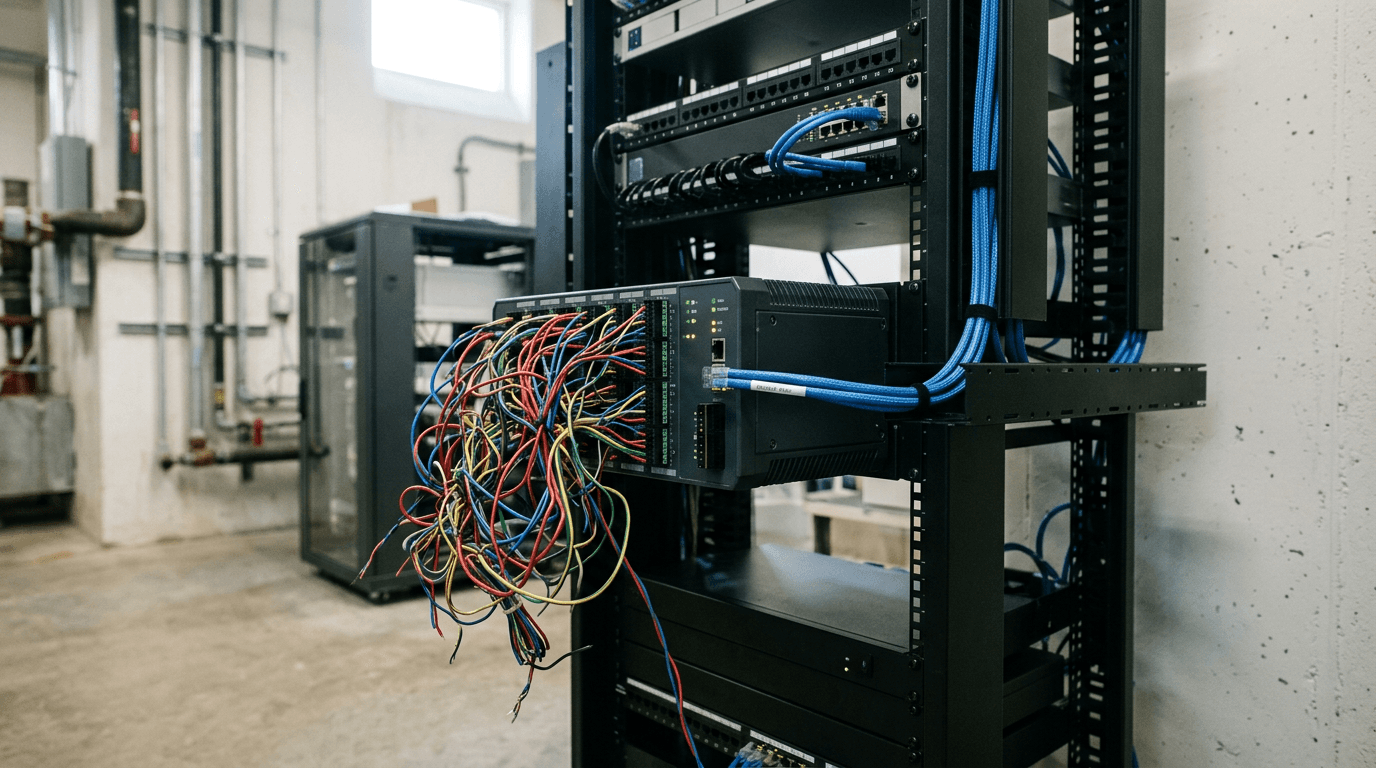
You discover a variable air volume (VAV) box has been fighting the perimeter baseboard heating for an entire winter because the supervisory controller lost its network binding. This is the exact moment facility managers realize a building management system is not a passive digital dashboard; it is an active, distributed control network with direct physical consequences. When an integration relies on default factory setpoints and flat network topologies, mechanical assets wear out prematurely and energy waste goes unnoticed for months. This guide details how to structure, integrate, and secure a supervisory architecture that actually controls your facility, detailing the protocol standards, data ontologies, and network boundaries required to make it work safely.
Quick Summary
A supervisory facility architecture is a localized network of field controllers, sensors, and global logic engines that coordinates mechanical equipment. It normalizes proprietary hardware languages into a single operating environment to enforce global schedules and environmental setpoints across an entire commercial real estate portfolio.
- Auditing the mechanical baseline prevents software logic conflicts downstream.
- Standardizing on IP-level communication reduces serial bus latency and token drops.
- Applying a strict data tagging ontology makes broad portfolio analytics possible.
- Isolating operational technology on dedicated subnets contains lateral network breaches.
Table of Contents
- 1. Audit the existing building management system architecture
- 2. Standardize the field-level communication protocols
- 3. Structure the operational data tagging ontology
- 4. Configure the supervisory control sequences
- 5. Secure the operational technology network perimeter
- Common Pitfalls & Troubleshooting
- FAQ
1. Audit the existing building management system architecture

The hardware layer dictates your integration limits
Hardware physically actuates facility valves and dampers. You must document this equipment exactly. Do this before writing a single line of supervisory logic. Often, building construction engineering separates the mechanical installation from the network integration. This leaves facility managers with a disjointed collection of standalone controllers. A chiller plant might use a modern IP-based gateway. Meanwhile, the terminal units on the floors above rely on proprietary application-specific integrated circuits (ASICs) installed twenty years ago.
Modern supervisory platforms cannot magically interpret legacy, undocumented field bus traffic. They require specific hardware gateways. You must physically inspect the electrical panels. Document the make and model of the existing direct digital control (DDC) hardware. Next, verify the analog inputs (like thermistors) and digital outputs (like fan relays). Integrators frequently make a major mistake at this stage. They assume all field devices on a network trunk share the same protocol version. Later, they discover half the building uses a locked, proprietary language. This requires a costly third-party driver to translate.
Practical rule: Map and manually command every physical input and output point from the field controller level before attempting to write any global supervisory logic.
2. Standardize the field-level communication protocols
Protocol translation introduces severe network latency
Field controllers communicate over specific data protocols, most commonly BACnet, Modbus, or KNX. The medium carrying these protocols makes a massive difference in system performance. BACnet over MS/TP (Master-Slave/Token-Passing) runs on an EIA-485 serial cable. It requires controllers to pass a digital token in a continuous loop; a controller can only transmit data when it holds the token. If you have sixty devices on a single serial trunk polling at 9600 baud, requesting a temperature update can take several seconds.
Upgrading to BACnet/IP shifts this communication to standard Ethernet networks, eliminating token-passing bottlenecks and allowing concurrent data transmission. When integrating disparate equipment, standardize on BACnet/IP wherever the hardware supports it. The primary mistake made during protocol standardization is failing to match the baud rates and MAC addresses on legacy serial trunks. If a single new VAV controller is added to an existing MS/TP trunk and set to 38400 baud while the rest of the network runs at 76800 baud, the entire network trunk will crash, taking dozens of mechanical units offline simultaneously. You must audit the baud rate of the existing trunk with a network diagnostic tool before landing the communication wires on a new device.
3. Structure the operational data tagging ontology
Untagged data points render facility analytics useless
When a supervisory controller pulls data from field devices, it sees thousands of data points. By default, these points inherit whatever arbitrary name the installing technician typed into the configuration software. One technician might name a discharge air temperature sensor "AHU1_DAT", while another names the identical sensor on a different floor "Unit1_DischargeTemp". When you attempt to run portfolio-wide energy analytics, the database cannot recognize that these two points represent the exact same physical concept.
Implementing a strict data ontology, such as Project Haystack or the Brick Schema, applies standardized metadata tags to every single point in the database. Instead of relying on the text string "AHU1_DAT", the point is tagged with discharge, air, temp, sensor, and ahu. Without this unified semantic model, a smart building remains a collection of dumb silos. The critical error organizations make is skipping the tagging process to save time during the initial commissioning phase. Retrospectively tagging fifty thousand data points across a campus is a manual, highly expensive process. Enforce semantic tagging requirements in the master integration specification before any field controllers are ordered.
4. Configure the supervisory control sequences
Conflicting setpoints drive energy waste and equipment wear
Supervisory logic replaces manual operation with dynamic algorithms that adjust mechanical outputs based on environmental feedback. This is executed through Proportional-Integral-Derivative (PID) loops. A PID loop calculates the error between the current space temperature and the desired setpoint, then modulates a valve or damper to close that gap. Effective building automation relies on dynamic reset sequences rather than static setpoints; for example, resetting the chilled water supply temperature based on the position of the cooling valves throughout the building (Trim and Respond logic).
Integrators frequently leave PID loop settings at their factory defaults, which rarely match the actual fluid dynamics of the specific mechanical system. This causes the control loop to "hunt" - opening and closing a valve rapidly because the integral time is too short to allow the system to stabilize. This hunting behavior burns out physical valve actuators in a matter of months and causes severe temperature swings in the occupied space. You must manually trend the valve position against the discharge air temperature during commissioning; if the graph looks like a tight sine wave, the loop requires immediate manual tuning to widen the proportional band.
5. Secure the operational technology network perimeter
Direct internet access exposes unpatched field controllers
Operational Technology (OT) networks were historically designed with the assumption of physical security, meaning the protocols transmit data in plain text without authentication. Modern integrations pull this telemetry into cloud environments for predictive maintenance. However, migrating field telemetry to modern cloud analytics pipelines often requires replacing legacy MQTT bridges that relied on retired infrastructure like the google internet of things core, shifting instead to active, highly secured hyperscaler IoT hubs.
Bridging legacy local networks to cloud pipelines creates a massive vulnerability if handled poorly. The most catastrophic mistake facility teams make is port-forwarding the supervisory controller's web interface directly to the public internet to enable remote access for vendors. Search engines specialized in IoT devices constantly scan for open BACnet ports (47808) and default web interfaces. Once an attacker accesses the supervisor, they can override physical equipment or pivot laterally into the corporate IT network. You must isolate all field controllers on a dedicated, non-routable Virtual Local Area Network (VLAN) and force all remote vendor access through a hardened Virtual Private Network (VPN) secured with multi-factor authentication.
Common Pitfalls & Troubleshooting
When a facility experiences a mechanical failure, the supervisory network often presents the exact same generic symptom for entirely different root causes. A classic example is a high static pressure alarm on a central Air Handling Unit (AHU), which causes the main supply fan to ramp to 100% speed, ultimately tripping the physical high-limit safety switch and shutting down the unit. This looks identical on the dashboard regardless of the cause, but requires entirely different troubleshooting paths.
Cause 1: Failed static pressure sensor The physical sensor in the ductwork has failed and is transmitting a false reading of zero inches of water column back to the controller. The PID loop sees zero pressure, assumes the fan is off, and commands the variable frequency drive to 100% to compensate. Fix: Check the voltage output directly at the sensor terminals with a multimeter. If the duct is pressurized but the sensor outputs zero volts, replace the physical sensor. Do not attempt to fix this in the software.
Cause 2: Supervisory schedule conflict (Most Common) The global schedule on the supervisory controller commanded all downstream VAV dampers to close for the weekend, but a separate, unlinked logic block allowed the main AHU fan to continue running. With all dampers closed, the fan pressurizes a dead-ended duct, tripping the safety switch. Fix: Implement a software interlock in the supervisory logic that completely prevents the main AHU fan from starting unless the system proves that at least 30% of the downstream terminal dampers are physically open.
Cause 3: Fire alarm relay failure The hardware interlock between the fire alarm control panel and the HVAC controller has failed. The relay that normally breaks the fan circuit during a smoke event has failed in the open position, mimicking a fire shutdown. Fix: Temporarily bypass the relay at the terminal block to prove the fan can run, confirming the failure is in the fire circuit relay and not the AHU controller. Replace the relay immediately; never leave a fire life-safety bypass in place.
FAQ
Why do BACnet MS/TP field controllers frequently drop offline during peak operating hours? Network collisions occur on serial MS/TP trunks when the supervisory server attempts to trend too many data points at very short intervals. If you request one-minute data logs from sixty devices simultaneously on a 38400-baud network, the physical wire cannot carry the traffic, causing token drops and forcing controllers offline. Increase the trend intervals to fifteen minutes or segment the serial trunk.
Should lighting control panels exist on the same network trunk as HVAC equipment? No. Lighting networks generate vastly different traffic profiles than HVAC equipment, often requiring instantaneous multicast commands to trigger lighting scenes across multiple floors. Running lighting traffic on an HVAC serial bus will bottleneck both systems. Keep them on physically or logically separated networks and integrate them only at the IP supervisory level.
How do you fix a hunting PID loop that is destroying valve actuators? Hunting occurs when the controller reacts too aggressively to small temperature changes. To fix it, you must increase the Proportional Band (which reduces the initial response size) and increase the Integral Time (which forces the controller to wait longer before applying further corrections).
What happens to field equipment when the main supervisory server reboots or fails? If the system is engineered correctly, the field controllers will fall back to their internal logic and local real-time clocks. The facility will continue to heat and cool based on the last known setpoints. However, if the integrator programmed critical logic (like the primary boiler staging) directly on the global supervisor rather than the local plant controller, the mechanical equipment will lock out entirely when the network drops. Always push critical safety and staging logic down to the field device level.